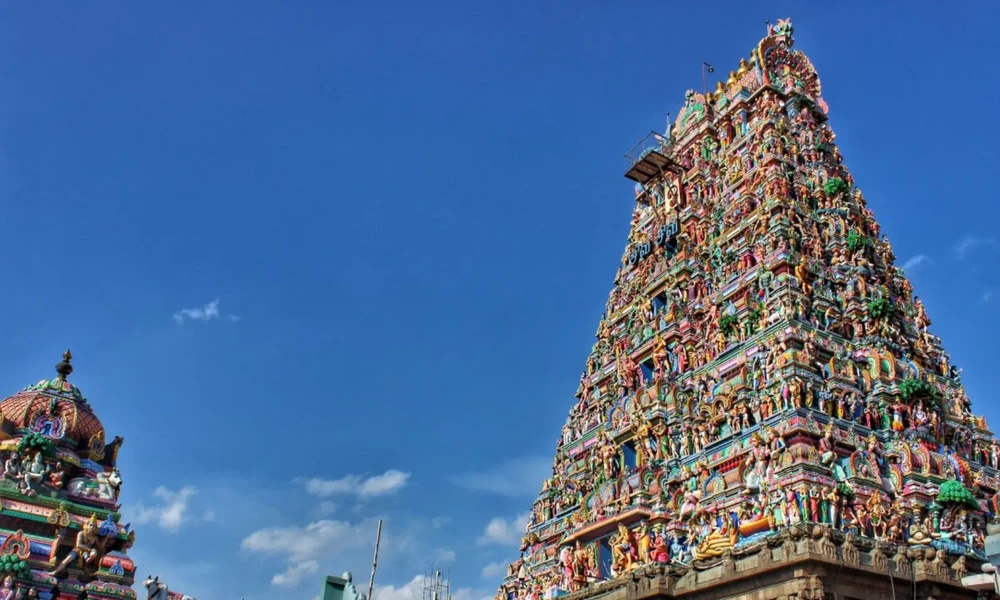
I had imagined Dravidian temples only in Madurai or Thanjavur, but this changed after visiting Chennai. The city boasts many temples that reflect Dravidian architecture, spanning more than one thousand years, starting from the early Pallava era to Vijayanagara. In four days of visiting these temples, I kept learning to lift my gaze skyward.
Dravidian architecture is easily recognisable if you know its main characteristics. Tall towers called gopurams are at entrances, pillared halls lead inside to a smaller shrine, a holy tank is nearby, and the surfaces of temples are replete with carvings and paintings. Chennai has it all, in areas of the city that still preserve its temples.
Starting at Kapaleeshwarar in Chennai
I began in Mylapore, at the Kapaleeshwarar Temple. The temple is dedicated to Shiva, and its eastern gopuram rises about 37 metres above the street. It is covered in painted figures of gods, sages and animals in layered tiers. The colours are bright, and the whole tower looks almost like a stack of small stories.
Most of the structures were rebuilt in the 16th and 17th centuries, although the temples themselves date back to earlier times. As I moved around, I arrived at the larger tank at the back of the temple.
Pallava roots at Parthasarathy in Chennai
Parthasarathy Temple in Triplicane is dedicated to Krishna as Arjuna’s charioteer. It dates back to Pallava times, around the 8th century, though the Cholas and later rulers added to it. The result is a compact complex with several layers of history.
The raja gopuram is simpler than Kapaleeshwarar’s, with fewer tiers and quieter detail. I spent more time on the inner shrines, where the stonework is tighter and plainer. It is a useful stop for seeing how the style shifted between periods. Triplicane’s narrow lanes are also worth a short walk afterwards.
Sea breeze at Marundeeswarar in Chennai
Marundeeswarar Temple is near the Bay of Bengal. It is a temple dedicated to Shiva. The pillared hall is very spacious and serene. Although the temple tower is shorter than the tower in Mylapore, the artistically carved pillars captivated my attention for hours.
I visited in the late afternoon when there were not too many visitors. I walked along a path adjacent to the temple to reach the seashore. You can enjoy a wonderful day in the place provided you organise activities and timing well.
Day trip toChennai’s Kanchipuram and Mamallapuram
For earlier examples, a day trip is worth the effort. Kanchipuram is roughly 75 kilometres away, and the Kailasanathar Temple there is a Pallava structure from around the 8th century. Built of sandstone, it has small shrines arranged around a courtyard. The carvings are worn but clear.
Mamallapuram is around 55 km south of the city. Its Shore Temple, which also goes back to the 8th century, is one of the oldest stone temples. The two locations help us understand how the Dravidian style began. Leave in the morning and bring along water with you.
Onward to Madurai from Chennai
I ended the trip by flying to Madurai from Chennai to see the Meenakshi Temple, since I wanted to compare the early Chennai temples with the later, grander versions. I chose a business cabin in Chennai for the short flight, partly to rest after several days on my feet. The extra legroom and a warm snack made the hour in the air feel unhurried.
What Chennai taught me about temple architecture
In the end, I learned how to read the temple like one reads the town. A gopuram shows its century, the pillars reflect the dynasty, and the tank explains how people lived at that time. Chennai deserves all the credit for this.