

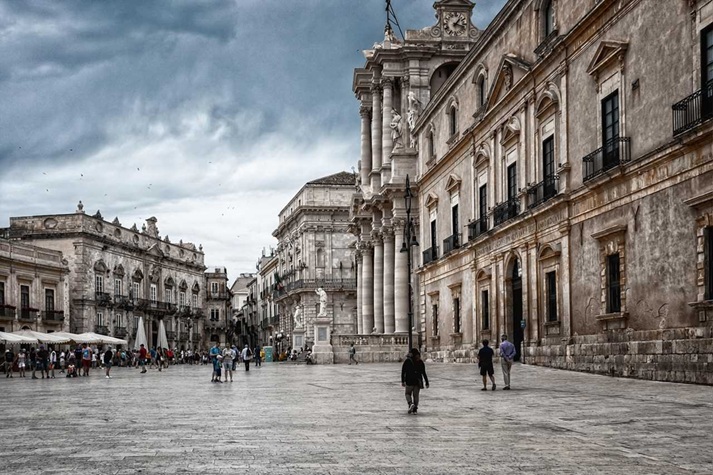
Syracuse is not a place where food exists apart from the city. It is embedded in the streets, the markets, the daily rhythm of Ortigia, and in the way conversations slow when plates arrive. Eating here is never an isolated event; it is a continuation of how the city functions. History has layered itself onto Syracuse without ever displacing the habits that matter most, and food remains one of the most stable of those habits.
Ortigia as the Natural Dining Room
Ortigia concentrates much of Syracuse’s culinary life into a walkable, human-scale setting. Narrow streets funnel toward the sea, opening unexpectedly onto small squares where tables appear at dusk without fanfare. Restaurants do not announce themselves loudly. Menus are often brief, sometimes handwritten, reflecting what arrived that morning rather than what was planned weeks before. For visitors, this creates a sense of trust rather than choice, an understanding that dinner is shaped by availability, not ambition.
Markets and Morning Signals
The day’s food story begins early. The local market is less about spectacle than function, with fish laid out according to size and freshness, and produce stacked with the logic of repetition rather than display. Watching chefs move through these stalls—quietly, decisively—reveals more about Syracuse’s dining culture than any tasting menu. The connection between what is bought in the morning and what appears on the plate at night remains unusually direct.
Tradition as Living Practice
What stands out most in Syracuse is how tradition remains active rather than preserved. Recipes are adjusted quietly, portions recalibrated, ingredients swapped according to season, but the underlying logic stays intact. This flexibility keeps the food from feeling archival. Even dishes with deep historical roots are treated as part of the present, meant to be eaten regularly rather than revered from a distance.
Fine Dining Without Excess
Fine dining in Syracuse rarely leans toward theatricality. Even at its most refined, the experience is grounded in proportion and restraint. Dishes favor clarity over complexity, allowing ingredients to remain recognizable rather than transformed beyond recognition. This approach feels less like a stylistic choice and more like a reflection of place, where excess would feel out of step with the surrounding landscape and pace of life.
The Role of Time at the Table
Meals here are structured by time rather than courses. Lunch stretches when conversation allows it, dinner extends naturally into the evening as temperatures drop and streets fill. There is little pressure to move on, to free a table, or to compress the experience. This unhurried approach often defines what travelers later describe as a luxury getaway in Syracuse, not because of formality, but because of the freedom to linger without explanation.
Wine, Simplicity, and Local Logic
Wine lists tend to follow the same philosophy as the food. Regional selections dominate, not out of obligation but practicality. Local varieties suit the dishes, the climate, and the moment of consumption. Pairings feel intuitive rather than instructional. A glass arrives when it makes sense, not when a rule demands it. The result is an experience that feels cohesive without being curated.
Evenings Between Sea and Stone
As night settles, dining spaces blur into the city itself. Tables edge closer to the street, conversations mingle, and the sound of cutlery competes gently with voices and passing footsteps. The sea remains present, sometimes visible, sometimes only audible. These evenings are less about destination restaurants and more about continuity, where one meal leads naturally into a walk, a pause, or a final glass taken standing.
Leaving with a Calibrated Palate
Food memories from Syracuse tend to be specific rather than dramatic. A dish repeated twice because it felt right the first time. A restaurant revisited without discussion. A sense of being fed well and regularly rather than impressed. This quiet satisfaction lingers longer than novelty, offering a clear understanding of how deeply food is woven into the city’s daily life.
Syracuse does not perform its cuisine.
It lives it, steadily and without interruption.
