

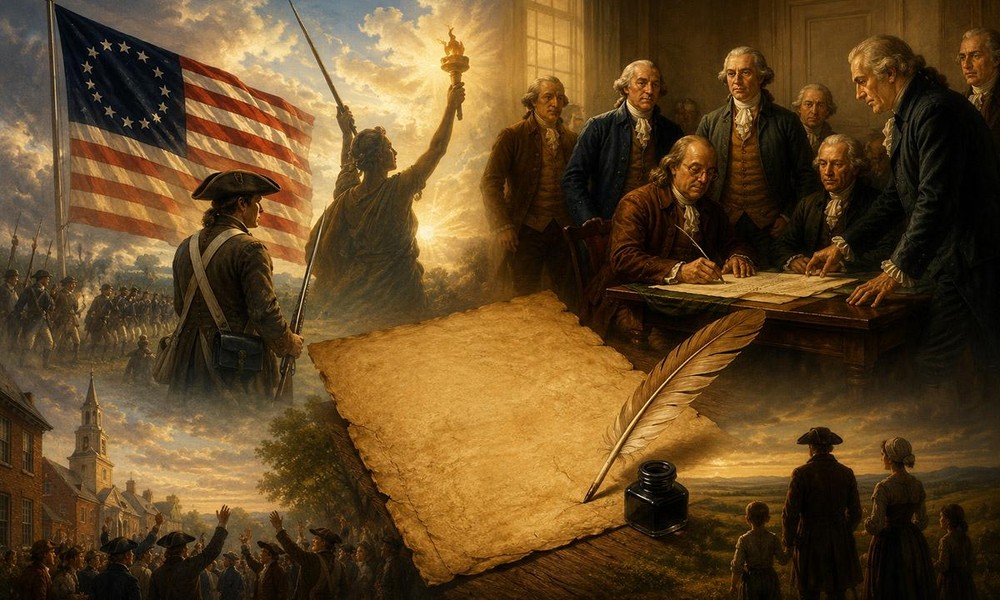
How a Revolutionary Document Shaped the Birth of a Nation and Influenced Democratic Ideals Worldwide.
Few documents in history have had an impact as profound as the Declaration of Independence. Adopted on July 4, 1776, during the height of tensions between the American colonies and Great Britain, this historic text formally announced the colonies’ decision to separate from British rule and establish themselves as independent states. However, the Declaration of Independence represented much more than a political announcement. It articulated a powerful vision of human rights, government accountability, and individual liberty that continues to influence democratic societies around the world.
The Declaration emerged during a period of growing frustration among American colonists who believed that the British government had violated their rights through unfair taxation, restrictive policies, and a lack of political representation. By publicly outlining these grievances and asserting universal principles of equality and self-government, the document transformed a colonial rebellion into a broader struggle centered on political philosophy and human rights.
Although written more than two centuries ago, the Declaration of Independence remains a cornerstone of American identity and a symbol of the enduring pursuit of freedom and equality. Understanding its importance gives valuable insight into the origins of the United States and the principles that continue to shape democratic governance today.
“The Declaration of Independence did more than create a nation-it introduced ideas about liberty and equality that continue to inspire people around the world.”
Historical Context: Why the Declaration Was Written
The Declaration of Independence did not emerge suddenly. It was the culmination of years of escalating tensions between the thirteen American colonies and the British Crown.
Following the costly French and Indian War (1754-1763), Great Britain sought additional revenue from the colonies through a series of taxes and regulations. Many colonists believed these measures violated their rights as English subjects because they lacked representation in the British Parliament.
Several events intensified colonial dissatisfaction, including:
- The Stamp Act of 1765
- The Townshend Acts
- The Boston Massacre (1770)
- The Tea Act of 1773
- The Boston Tea Party
- The Intolerable Acts
- Armed conflicts at Lexington and Concord in 1775
Initially, many colonists sought reconciliation rather than independence. However, repeated disputes and growing distrust convinced increasing numbers of Americans that separation from Britain had become necessary.
In June 1776, the Second Continental Congress appointed a committee to draft a formal declaration explaining the colonies’ decision to pursue independence.
The committee included:
- Thomas Jefferson
- John Adams
- Benjamin Franklin
- Roger Sherman
- Robert R. Livingston
Jefferson drafted most of the text, drawing upon Enlightenment philosophy and colonial experiences to create one of history’s most influential political documents.
The Declaration Established Fundamental Principles of Human Rights
One reason the Declaration remains significant is its articulation of universal principles concerning human rights and the purpose of government.
Among its most famous passages is the assertion:
“We hold these truths to be self-evident, that all men are created equal…”
The document further declares that individuals possess certain unalienable rights, including:
- Life
- Liberty
- The pursuit of Happiness
These ideas reflected the influence of Enlightenment thinkers such as John Locke, who argued that governments exist to protect the natural rights of citizens.
According to the Declaration:
- Governments derive their powers from the consent of the governed.
- Citizens have the right to alter or abolish governments that fail to protect their rights.
- Legitimate authority depends upon serving the interests of the people.
Although these principles were not fully realized at the time-particularly regarding slavery, women’s rights, and political participation-they established ideals that future generations would invoke in efforts to expand equality and justice.
The Declaration’s language transformed political philosophy into a practical argument for self-government and individual freedom.
It Provided Justification for Independence
The Declaration of Independence served an important practical function by explaining why the colonies believed separation from Great Britain was justified.
The document includes an extensive list of grievances against King George III.
Colonists accused the king of the following:
- Obstructing representative government
- Imposing taxes without consent
- Maintaining standing armies during peacetime
- Denying fair trials
- Interfering with colonial legislatures
- Restricting trade
- Violating established rights
By detailing these complaints, the Declaration sought to demonstrate that independence was not a reckless act of rebellion but a necessary response to repeated abuses of power.
This justification served multiple audiences:
Colonial Citizens
The Declaration unified support among Americans by explaining the reasons behind independence.
Foreign Governments
The document encouraged potential allies, particularly France, to view the colonies as legitimate political entities deserving diplomatic recognition.
Future Generations
It preserved the colonists’ perspective regarding why revolution had become necessary.
Providing this rationale helped strengthen both domestic and international support for the American cause.
“The Declaration framed independence not as an act of defiance alone, but as a defense of fundamental rights and representative government.”
The Declaration Influenced Democratic Movements Around the World
The significance of the Declaration extends far beyond the borders of the United States.
Its principles inspired numerous democratic movements and declarations of rights throughout history.
Examples include:
The French Revolution
The Declaration of the Rights of Man and of the Citizen echoed many concepts concerning liberty and equality introduced by the American Declaration.
Latin American Independence Movements
Leaders seeking independence from colonial powers often embraced similar arguments regarding self-determination and natural rights.
Abolitionist Movements
Advocates for ending slavery frequently invoked the Declaration’s promise of equality to challenge injustice.
Women’s Suffrage
At the 1848 Seneca Falls Convention, activists adapted the Declaration’s language in the Declaration of Sentiments, demanding equal rights for women.
Civil Rights Efforts
Leaders such as Martin Luther King Jr. referenced the Declaration’s ideals when advocating for racial equality and social justice.
The enduring relevance of these principles demonstrates the document’s influence as a source of inspiration for individuals seeking expanded freedoms and human rights.
Recognizing the Declaration’s Complex Legacy
While celebrating the Declaration’s contributions, historians also acknowledge its contradictions.
At the time of its adoption:
- Slavery remained legal throughout much of the colonies.
- Women lacked political rights.
- Indigenous populations were excluded from the document’s promises.
- Property requirements limited participation in governance.
These inconsistencies have prompted ongoing discussions regarding the gap between America’s founding ideals and historical realities.
However, many scholars argue that the Declaration’s enduring importance lies partly in its aspirational nature.
Its principles established standards against which future generations could measure progress and advocate for change.
Movements seeking greater equality often relied upon the Declaration itself to argue that American society should more fully embody its stated values.
This dynamic illustrates how foundational ideals can both reflect historical limitations and inspire continued efforts toward broader inclusion and justice.
Why the Declaration Still Matters Today
More than 250 years after its adoption, the Declaration of Independence continues to hold significance.
Its principles encourage reflection on important questions:
- What responsibilities do governments have to citizens?
- How should individual rights be protected?
- What role does civic participation play in democracy?
- How can societies work toward greater equality and justice?
The Declaration remains an important educational tool because it helps students understand the following:
- The origins of the United States
- The development of democratic institutions
- The evolution of civil rights movements
- The ongoing pursuit of liberty and equality
Its influence extends beyond history classrooms into contemporary conversations about citizenship, governance, and human rights.
Studying the Declaration provides opportunities to appreciate both the achievements and the challenges associated with democratic ideals.
Frequently Asked Questions
Why was the Declaration of Independence written?
The Declaration was written to formally announce the American colonies’ separation from Great Britain and explain the reasons for independence.
Who wrote the Declaration of Independence?
Thomas Jefferson drafted most of the document with input from a committee appointed by the Continental Congress.
What are the main ideas in the Declaration?
Key principles include natural rights, equality, government by consent, and the right to alter governments that fail to protect citizens’ freedoms.
Why is the Declaration important today?
The document continues to influence discussions about democracy, civil rights, individual freedoms, and government accountability.
Did the Declaration immediately provide equal rights for everyone?
No. Many groups, including women, enslaved individuals, and Indigenous peoples, were excluded from full participation. However, later movements used the Declaration’s ideals to advocate for expanded rights.
